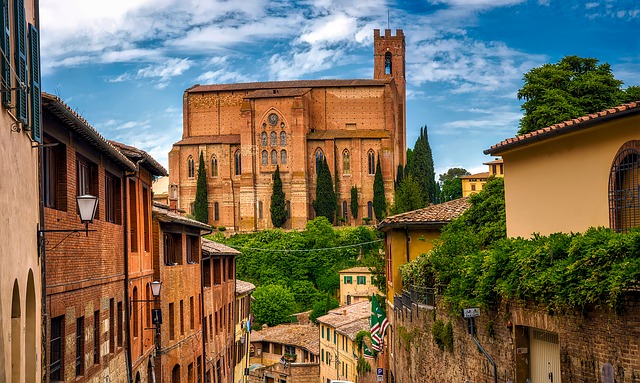
On the border between Tuscany and Umbria, where the landscape is softened by rolling hills, endless fields and dreamy rows of cypresses, there is one of the most suggestive areas of Central Italy. This zone is characterized by charming places where peace and silence reign uncontested and where nature, strategically cultivated to produce prestigious wines and oil, is the protagonist of a show so fascinating to look unreal, almost magical. This 3-day itinerary will take you through the wonders of Siena, one of the Tuscany’s Unesco World Heritages. Then crossing the breath-taking Chianti countryside, studded with elegant cypress trees, you will reach the beautiful town of Perugia, one of the main Etruscan cities still present in Italy. From Perugia, you will travel to another Unesco World Heritage, the Franciscan structures of Assisi. Finally, you will spend a relaxing afternoon in the wild Maremma area, at the Saturnia’s natural thermal bath, fed by hot springs trickling down a formation of rocks. Let’s start our trip!
Day one: SienaYou have probably heard of Siena, the Tuscan town first settled in the time of the Etruscans and famous for the Palio, a horse race held twice a year. The heart of this town is its central square, known as Il Campo, where the Palio is run (if you have watched the James Bond movie, Quantum of Solace, you should remember it). The fascinating history of Siena goes back to the foundation of Rome: according to the tradition, Siena was founded by Senius, son of Remus, one of the two legendary founders of Rome. No wonder, hence, that Siena’s emblem is the wolf who suckled Remus and Romulus.
Piazza del CampoOur trip starts exactly from the shell-shaped Piazza del Campo, whose architectural integrity is renowned worldwide. Before the thirteenth century this square was home to one of the biggest town’s marketplaces, and it remains the focal point of public life in Siena. Il Campo is surrounded by the Palazzo Pubblico (or Palazzo Comunale) and its magnificent Torre del Mangia, as well as by many elegant palazzi signorili. If you love art, the Palazzo Pubblico is worth a visit: it hosts the spectacular cycle of frescoes called “Good and Bad Government” by Ambrogio Lorenzetti. The particularity of these frescoes is that the subject matter is not religious, but civic: in the fourteenth century, the Republic of Siena was one of the most powerful Italian city-states, filled with bankers and merchants. Given the turbulent time for politics (that century was characterized by continuous ferocious party struggles), the series was commissioned by the city council to create a powerful reminder of the effects of political decisions. The ticket for the Palazzo Pubblico costs 8€ if booked online ( here you can find the website to book it); while children under 11 years old do not have to pay. Finally, at the northwest edge of the square you will find the Fonte Gaia, the largest fountain of Siena. Originally decorated with sculptures by Jacopo della Quercia, the fountain was then replaced in 1866 by a copy made in Carrara marble (a variety of marble much stronger than the marble of the Montagnola used by della Quercia). The new fountain also omits the original two nude statues of Rhea Silvia and Acca Larentia, which were found too pagan by the nineteenth-century Siena’s city fathers.
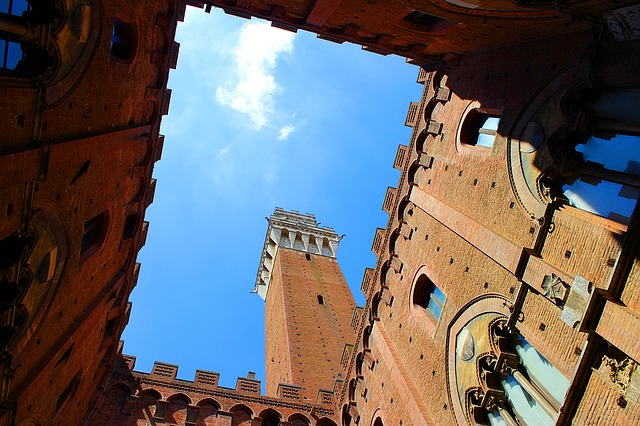
Built in 1338-1348, the Tower located in the Piazza del Campo was one of the tallest secular towers in medieval Italy. More precisely, its 102 metres made it the second tallest tower after Cremona’s Torrazzo (112 metres). The tower, divided into several visually distinct levels, has been replicated many times in several countries (you can find similar towers in Boston, Birmingham, Madrid and Waterbury, Connecticut). Without doubt, Torre del Mangia offers one of the most stunning views of Siena, but the climb can be a bit challenging: to reach the top you will have to climb over 400 steps. For this reason, we suggest that you wear comfortable shoes and clothes! The adult ticket costs 10€, while kids under 11 years old can climb up for free. Family tickets for two adults and two children between 11 and 18 years old are available and cost 25€. If you want to visit both the Torre and the Civic Museum, you can buy a cumulative ticket costing 20€. Remember: this kind of ticket can only be purchased at the ticket office for the Torre since it isn’t available at the museum’s ticket office.
The Duomo of Siena, known also as the Cathedral of Santa Maria Assunta, is famous not only as an amazing example of Romanesque-Gothic church, but also as the house to many pieces of art signed by authors such as Michelangelo, Nicola Pisano, Donatello, Pinturicchio. Among the others, the Feast of Herod by Donatello and the pulpit made of Carrara Marble deserve to be mentioned. Sculpted by many authors, among whom Nicola Pisano, between 1265 and 1268, the pulpit is an expression of the northern Gothic style of that time (although classical influences are visible in some elements). Furthermore, underneath the eastern bays of the choir of the Cathedral, you will find the Baptistry, whose most important part is the hexagonal baptismal font, containing sculptures by Donatello, Jacopo della Quercia, Lorenzo Ghiberti and others; while under the Cathedral, extraordinary frescoes of the Sienese school of the thirteenth century are contained in the Crypt. Last but not least, inside the Cathedral, on the left side, you will find the Piccolomini Library, dedicated to Pope Pius II. This library is truly a gem, adorned by wonderful frescoes and golden decorations made by Pinturicchio and Raphael Sanzio. Make sure you don’t miss it before leaving the Cathedral! To visit the Duomo, you can purchase the cumulative ticket called OPA Si Pass (it allows you to visit the Cathedral, Crypt, Piccolomini Library, Baptistery and the Museum of the Opera del Duomo, saving more of than 50% on individual tickets). You can buy the OPA Si Pass from the ticket offices in the museum the Piazza del Campo, or at the ticket office of the Museo dell’Opera. The inclusive ticket is valid for 3 days and costs 12€ from from March 1-October 31 and € 8 from November 1 February 28. Children under 11 enter the Cathedral free.
Museo dell’Opera del DuomoHere you will admire the originals of many works contained in the Cathedral and some of the must-see treasures of Italian art, such as the renowned Maestà by Duccio di Buoninsegna (the largest altarpiece ever painted), the Golden Rose by Bernini, the Madonna and Child by Donatello and the Crucifix by Pisano. The opening time of the Museum and the Cathedral varies during the year. March 1 – November 2: 10.30 am – 7 pm; Cathedral Public holidays and Sundays 1.30 pm – 6 pm; Cathedral prefestive 10.30 am – 6 pm. November 3 – February 28: 10.30 am – 5.30 pm; Cathedral Public holidays and Sundays 1.30 pm – 5.30 pm; Cathedral prefestive 10.30 am – 5.30 pm. December 26 – January 6: 10.30 am – 7 pm; Cathedral Public holidays and Sundays 1.30 pm – 5.30 pm; Cathedral prefestive 10.30 am – 5.30 pm.
Via Fusari and via Banchi di SopraThese streets are the main shopping streets in Siena. Via Fusari hosts a wonderful shop selling handmade ceramics inspired by the Palio’s contrades (they have also a website where you can find some photos of their products). Via Bianchi di Sopra has a variety of boutiques selling typical products, clothes, handmade bags and shoes. Get lost in these streets, discovering small shops rich of tradition and history.
Lunches and dinners in SienaIf you are looking for a cheap lunch, you should consider the Fiaschetteria Il Pulcino (Via Dei Termini 91). The menu changes every day and in general includes at least 3 typical types of fresh pasta (they are never banal, as tradition and innovation are mixed perfectly) and a couple of main dishes. This small restaurant has an excellent price/quality ratio: ingredients are always fresh and of high quality, and great attention is paid also in choosing suppliers. One dish of pasta costs around 6€, therefore you can have a lunch for less than10€. For dinner, you might decide to enjoy a truly Italian pizza…and here in Siena we have a wonderful place to taste it! Il cavaliere errante pizzeria (Piazza Provenzano 3). Inside the historical centre, with a unique view on Piazza Provenzano, this pizzeria will amaze you with its wide selection of pizzas, both traditional and original. Their pizzas are famous in Siena for their unquestionable goodness, and the restaurant is also well known for its quick service and courteous staff. One pizza and one drink will cost around 10€. Our tip: if the weather is good, you can eat outside the restaurant, in the wonderful lighted square. If you are looking for something more traditional, then why not try Osteria La Sosta di Violante(Via di Pantaneto 115)? Very good pasta (you should try the pici with capocollo ragù) and delicious main dishes, especially if you love meat (if so, try the chicken, pollo al mattone, or the Fiorentina)! Pasta from 7€, main dishes from 10€. The place is not so big, therefore it is better to book before going!
Gelato time!When in Rome, do as Romans do! You cannot visit an Italian city without trying its gelato! We recommend La Vecchia Latteria (Via San Pietro 10): lovely, full of taste gelato (according to many, the best in town) and great prices, three flavours for 3.50€! Cash only!
AccomodationLess than a 15-minute walk from Siena Train Station, you can find the Affittacamere Aura, offering nice brand new rooms with simple furnishing and private bathrooms. The position is ideal: Siena Cathedral is a just 20-minute walk away. Given that it is close to the station, the Affittacamere is perfect if you arrive by train, but we want to mention that the parking is free (the garage is in the building and there is an elevator, therefore it is safe and comfortable). Prices from 50€ per room. Another good solution with free parking is Pescaia, an elegant historic villa with its own garden, just 10 minutes far from the centre of Siena. Free parking and wifi, flat screen TV, private bathrooms and, for the rooms on the ground floor, private entrance. You will love it! Double rooms from 60€. Transportation
Hardly deniable, Ryanair and Easyjet offers very good deals for your holidays. Unfortunately, Siena is not among their destinations, but no panic! The closest destination is Pisa Airport, another wonderful city 2 hours far from Siena. How to get to Siena? The connection between the Airport of Pisa and the Siena is secured by the bus company Tiemme. One way tickets cost 15€, return tickets 28€. More information can be found at its page .
Once in Siena, either you have or do not have a car, it is better to forget about it! The treasures of Siena can only be discovered walking; therefore we recommend you find an accommodation with a free parking if you travel by car. If you want to take a bus, it would be better to buy a ticket in one of the ticket stores of the city (Atrio Stazione Ferroviaria, in Piazzale Rosselli; or Sottopassaggio pedonale della Lizza, in Piazza Gramsci): one ticket (lasting 1 hour) costs 1.30€ (if bought on the bus, 2€), while one-day tickets cost 4.80€.
Day two: PerugiaPerugia, wonderful town in Umbria region, is a medieval city famous for its winding staircases, its beautiful medieval gates and its famous decorated arches. Going into Perugia means forgetting about modernity and the last few centuries: today’s travelers will have the same experience as their predecessors had almost 150 years ago, in the nineteenth century. From the historic centre enriched by Etruscan, Roman and Gothic reminiscences, to the chocolate events that might be of interest to the most greedy, to the amazing Umbria Jazz festival, Perugia is one of the small Italian treasure that should not be forgotten.
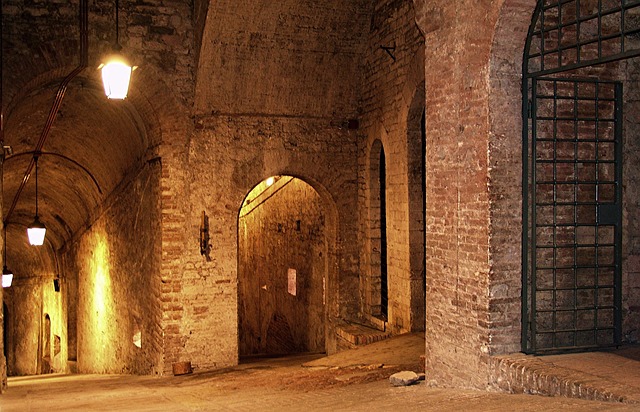
Our holiday starts from one of the most famous symbol of Perugia. Half a century ago, during the pontificate of Pope Paul III, Perugia, the last free city in Italy, was finally defeated in a war known as the Salt War. To remark the papal dominion, Pope Paul III commissioned the construction of an imposing fortress, that has become famous by the name of Rocca Paolina. From the outside, the only noticeable parts of the Rocca are the walls in Viale Indipendenza and the bastion along Via Marzia, which incorporates the beautiful Etruscan Porta Marzia. From the Porta, it is possible to access the foundations of the fortress. The interior of the Rocca is made of medieval streets and squares, and many connections between the fortress and the rest of the city are available through some escalators built inside the fortress. Inside the Rocca, you should not miss the hall of the papal guards. Never empty, the fortress is still considered an essential part of the city: a vibrant place for citizens and tourists. To visit it you do not have to pay the ticket, the access through Porta Marzia is open from 7 am to 8 pm, the other escalators are open from 6.15 am to 2 am.
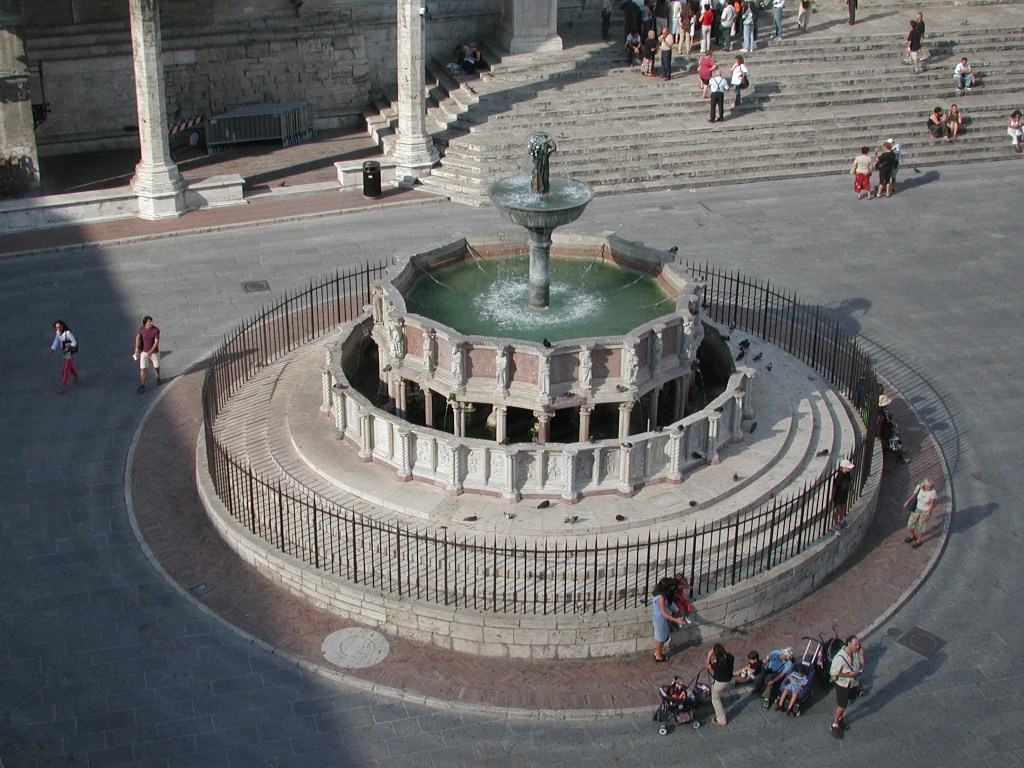
Built from 1278 to celebrate the autonomy of the free commune of Perugia, this fountain is still one of the most prestigious symbol of the city, created by famous artists such as Nicola Pisano, Giovanni Pisano and Boninsegna. The twenty-five sides of the basin are adorned with sculptures representing prophets and saints, the labours of the months, the symbols of the zodiac, images from Genesis, and famous facts from Roman history.
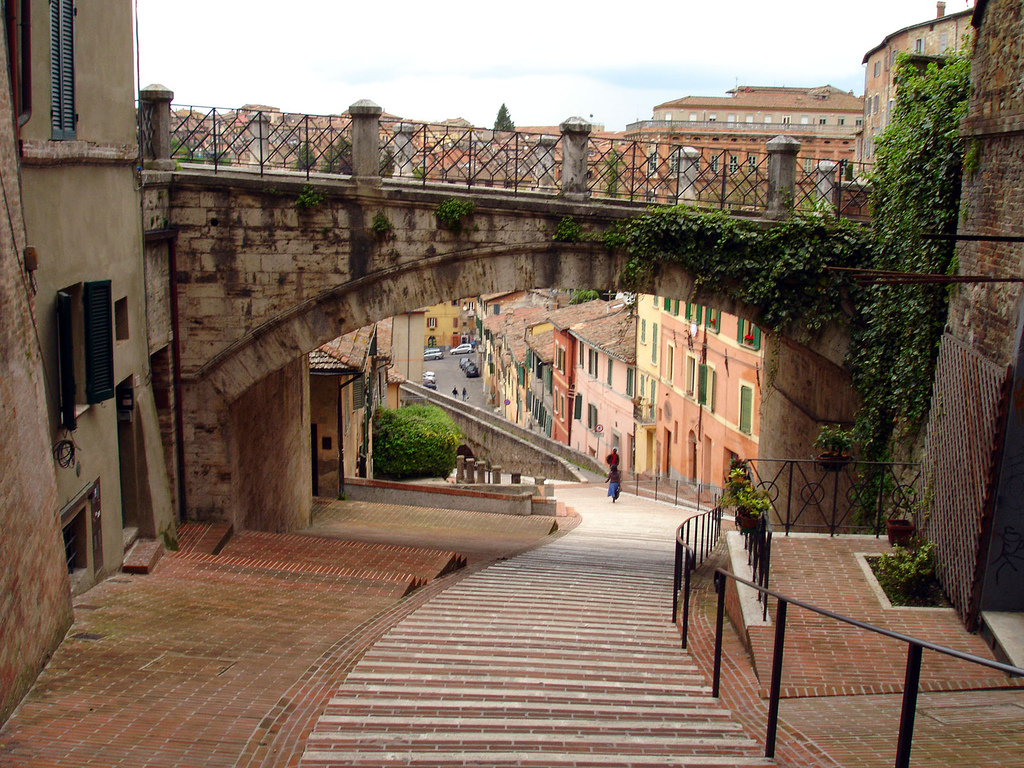
AcquedottoThe construction of the aqueduct, about 4 km long, started in 1254 under the guide of Bevignate and Boninsegna, and was completed in 1280. Without the help of pumps or other instruments, Bevignate and Boninsegna managed to impart to water the reverse motion only with the use of pressure: an extraordinary hydraulic endeavour! During the first half of the nineteenth century, once the aqueduct ceased its function, its last part was transformed into a pathway connecting the village of Porta S. Angelo to the Old Town. This pathway consists of a wondeful bridge supported by a dozen rounds with full arches, to which the parapet has been added.
The Palazzo dei Priori is home to the Commune of Perugia, the National Gallery of Umbria and the two largest medieval corporations: the Nobile Collegio della Mercanzia and the Noble College of the Cambio. The National Gallery preserves one of the richest art collections in Italy from the 13th to the 19th century, with works by Duccio di Boninsegna, Benedetto Bonfigli, Bartolomeo Caporali, Gentile da Fabriano, Beato Angelico, Benozzo Gozzoli, Piero della Francesca, Pinturicchio, Perugino, Orazio Gentileschi, Pietro da Cortona, Gian Lorenzo Bernini and others. The Gallery is open from March to September Tuesday-Sunday 8.30am-7.30pm. Tickets are free for under 18, cost 3,25€ for young between 18 and 25 years old, 6.50€ for over 25.
For lunch, theVivace (Corso Vannucci, 48) is one of the best option. Here you come to drink a glass of wine and tease your appetite with a board of local cheeses and Umbrian salami (10€). You will find also an aperitivo menu (8€), gourmet panini (8/10€), soups and salads (6€). It is possible to eat inside, or if you prefer to enjoy the beautiful view over Corso Vannucci, you can sit under the large umbrellas outdoors. Remember: here it is also possible to buy food and wine products! If you are looking for a cheap lunch, you could also consider the Dal mi Cocco Restaurant (Corso Giuseppe Garibaldi 12). This is a historic place in Perugia that offers a fixed menu (antipasto, two dishes of handmade pasta, one main dish, handmade bread and dessert), but different every day: it is not possible to choose among a huge selection, but it really does not matter. What the chef “imposes” is always sufficient to satisfy everyone who wants to taste typical Umbrian food and to fill the most stunning stomachs. Good quality, nice atmosphere and very convenient price: the fixed menu costs just 13€!
Our suggestion for the dinner is the Osteria A Priori (Via dei Priori, 39). If you love wine, this place is for you! Just take a look at the wine list, made only of regional labels, and at the list of artisan beers. This place is also perfect if you love Umbrian food: in addition to a typical product shop, it offers a very good menu at dinner. Prices around 15€. Open for lunch and dinner, closed on Tuesdays.
Yet another gelato!Don’t forget the lovely Gelateria Gambrinus (Via Luigi Bonazzi 3), where anyone has a hard job deciding what to take. The gelato is incredibly good (try the baci perugina flavour), and also cheap: 3 blobs for only 2.50€.
AccomodationLess than a 10-minute walk from Perugia Train Station, you can find the Affittacamere Renata & Massimo, offering nice parquet floors rooms with simple furnishing, refrigerator and free wifi. The bathroom and the kitchen are shared, but always very clean. Given that it is close to the station, the Affittacamere is perfect if you arrive by train, but we want to mention that the parking is free. Prices from 45€ per room. Another good solution with free parking is Petite Maison di Anna , a very nice apartment with a dining area and a kitchen equipped with oven. The apartment is just 30 minutes far from the centre of Siena, and it is very close to the train station. Free parking, free wifi and private entrance. If you are traveling with your pet, no problem: the apartment is pet-friendly! Double rooms from 50€. Transportation
By bus, the travel from Siena to Perugia will take 1.30 hour and will cost around 11€ Day three: Assisi and Terme di Saturnia
The medieval city of Assisi, added in 2000 to the UNESCO World Heritage list, is famous not only as the birthplace of St. Francis and Clare, but also as one of the main symbols of peace of the European Community. Several natural, historic and enogastronomic attractions make this city a perfect destination for a one-day trip. After having enjoyed the quiet of this wonderful city, why not try the naturally warm sulphurous water source known by the name of Terme di Saturnia? We think this last relaxing attraction would be the perfect end of your trip!
The Basilica di San FranciscoAssisi is home to the 13th century Basilica di San Francisco, where St. Francis lies. The Basilica hosts wonderful frescoes by numerous late medieval painters such as Giotto, Pietro Lorenzetti, Simone Martini and Cimabue. This is the largest basilica in Assisi, and comprises two churches known as the Upper Church and the Lower Church, as well as a crypt where the remains of the saint are interred. Because of the quality of the frescoes, the basilica is still considered a wonderful example of the development of the Italian art of that period. The architecture is balanced a synthesis of the Romanesque and Gothic styles, and its interchange with the spiritual message of the Franciscan Order has significantly contributed to developments architecture in the world. If you visit the Basilica, do not miss the ornate rose window set in the tympanum of the Lower Church: it has been claimed to be “the eye of the most beautiful church in the world”. The church can be visited without paying any ticket, unless you are a group of 7 or more people or you want a guide. In those cases, you should book you visit online, paying 2€ per person. From the last Sunday of March to the last Saturday of October, the basilica is open from 9 am to 5.30 pm (Lower Church) and from 9 am to 6 pm (Upper Church). The last entry to the lower church is allowed at 5 pm. From the last Sunday of October to the last Saturday of March, the opening time is 9-5.30, the last entry to the Church is at 4:30 pm. Remember: it is not possible to visit the basilica on Sundays and public holidays.
Piazza del ComuneThe square is the secular heart of Assisi, where you can find all the most important symbols of the civil power: the Palazzo del Capitano del Popolo, the Palazzo dei Priori and the Torre del Popolo. Furthermore, in the same square you can admire the ancient Roman Tempio di Minerva, built in the 1st century B.C. by will of two of the city’s quattuorviri, Gnaeus Caesius and Titus Caesius Priscus. The original façade has been preserved, with six Corinthian columns supporting the architrave and a small pediment. This temple could be considered as one of the symbols of the civil and religious life of Assisi: originally built as a religious building, subsequently it hosted a court with relative prison, and finally it was converted into a Christian church (the church of Santa Maria sopra Minerva).
Lunch in AssisiAs every touristic location, Assisi is full of small restaurants with touristic menu. For lunch, you might try Enoteca San Pietro (Via Borgo San Pietro, 18/B). Here you can tease your appetite with a menu including hand-made pasta and typical salumi for just 12.90€. You will find also nice pasta dishes (around 9€) and tasty main dishes typical of this region (10€). At the same price, you can also enjoy a typical Umbrian lunch at the Ristorante San Francesco di Assisi (Via Patrono d’Italia 22/A). This is a well-known restaurant in Assisi that offers a touristic menu with many choices: tagliatelle norcina, cheese gnocchi, pasta with tomato and sausages sauce… Good quality, nice atmosphere and very convenient price: the fixed menu costs just 12€!
Best ice-cream in townIn the historical centre of Assisi, try a lovely little café called Pasticceria Santa Monica (Via Portica 4/A). The gelato is delicious, as well as the pastries and the other sweets (try the meringhe)! We are sure, it will be love at first bite!
TransportationThe connection between Perugia and the the centre of Assisi is secured by the bus company Umbria Mobilità (bus line E007). One way tickets cost around 3€.I you are a group of 3 or 4 persons, you might decide to take a taxi. A taxi from the airport to the historic centre of Assisi will cost around 30€. For more information look at the taxi website and at the bus website
. Terme di SaturniaThese terme are free natural waterfalls just outside the town of Saturnia. The waterfalls rush into pools that have been used by locals as natural spa for centuries: the water is 37°C constantly and comes from a source underground containing sulphur and other minerals. It is not easy to reach the terme, but you could decide to rent a car for one day: after having visited the terme, you could drive directly to the airport! From Assisi, the terme are 2.30 hours far, but we are sure you will love them! The welcoming waters together with the picturesque beauty of the Tuscan landscape makes this place one of the secret gems of Southern Tuscany.

 Best Italy Trips